
Australia’s Social Media Reforms Under Fire: Prime Minister Anthony Albanese Defies US Criticism Amid Global AI Safety Concerns
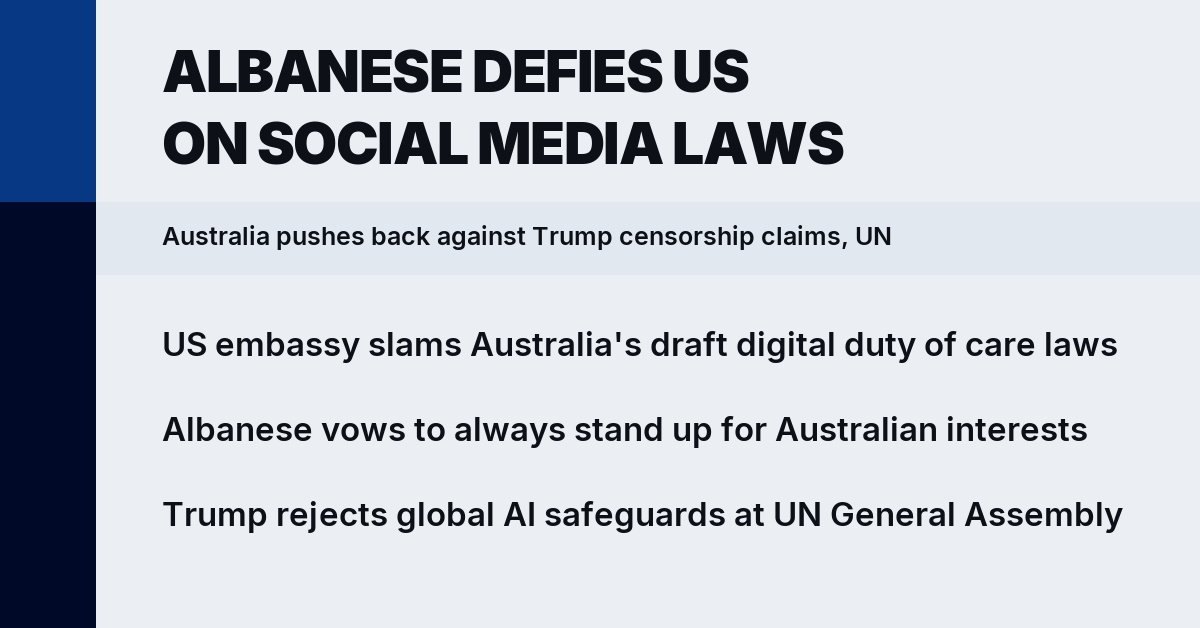
- Australia’s proposed digital duty of care laws have sparked a fierce backlash from the US, with claims they amount to “extraterritorial censorship of protected speech”
- Prime Minister Anthony Albanese has pushed back against the criticism, saying he will “always stand up for Australian interests” and defend the reforms
- The US and China are engaged in a high-stakes battle for AI supremacy, with President Donald Trump rejecting calls for global safeguards and instead rebranding AI as “super intelligence”
- Australia has joined 21 other countries in calling for urgent action to keep AI “under human control”, warning that the pace of development could outpace the ability to manage emerging risks
Prime Minister Anthony Albanese has found himself at the centre of a heated debate over Australia’s social media reforms, with the US launching a rare criticism of the proposed laws.
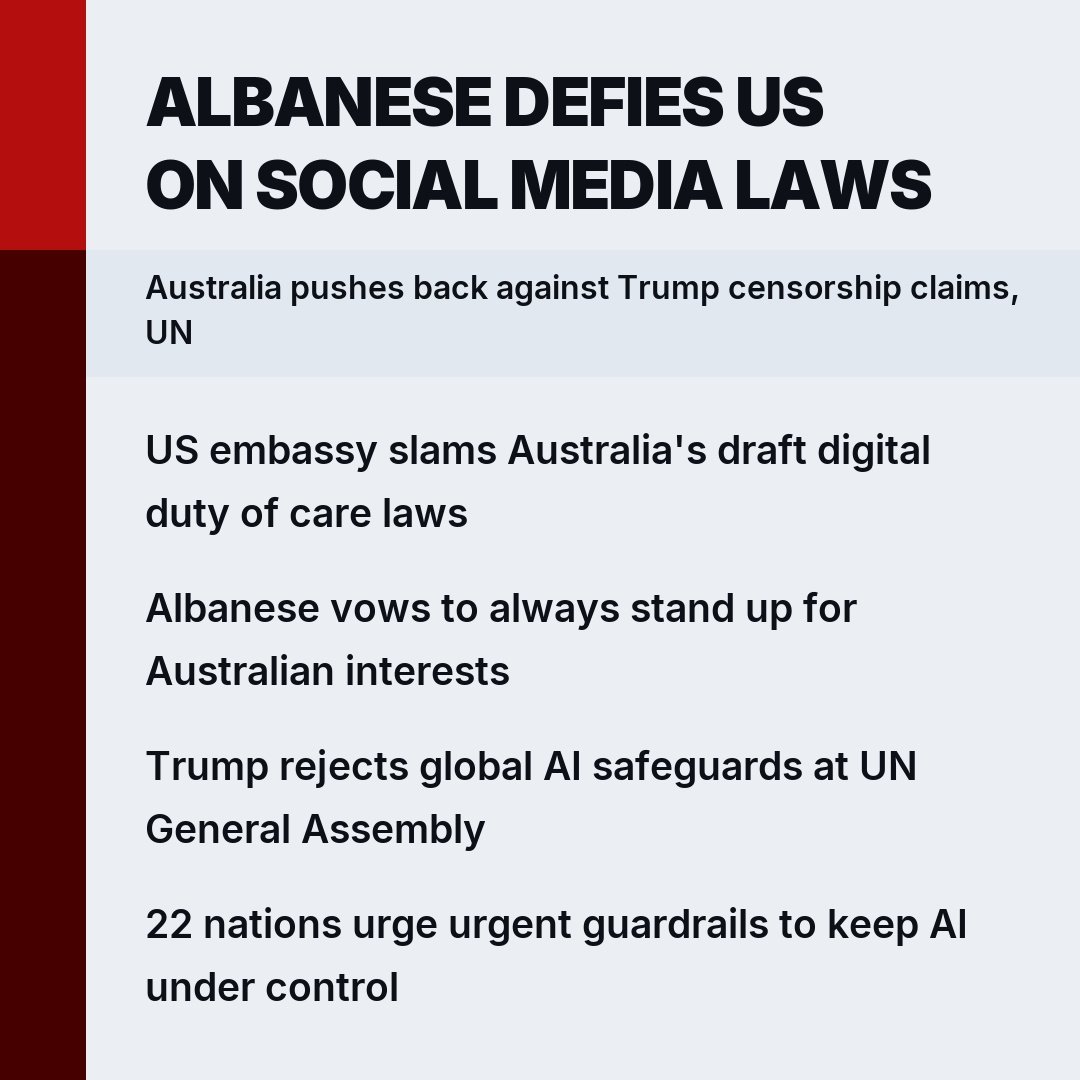
The US embassy has made a submission on the draft legislation, claiming it would amount to “extraterritorial censorship of protected speech” and calling on Australia to exempt US social media companies from the reforms.
But Mr Albanese has refused to back down, saying he will “always stand up for Australian interests” and defend the proposed digital duty of care laws.
The reforms would require tech giants to pre-emptively address harms and give users a choice to opt into or out of algorithms.
Mr Albanese has stressed that the government will “engage constructively” before finalising the legislation, and has expressed hope that the whole of parliament will support it.
However, the opposition has echoed the US’s censorship concerns, with Coalition frontbencher Andrew Bragg warning that the proposed changes could give “unelected bureaucrats” too much power and pose a threat to free speech.
The debate over Australia’s social media reforms comes as the world grapples with the implications of artificial intelligence.
The US and China are engaged in a high-stakes battle for AI supremacy, with President Donald Trump rejecting calls for global safeguards and instead rebranding AI as “super intelligence”.
Mr Trump has previously described dire warnings about the safety of AI as a “hoax”, and has made it clear that he will not support any attempts to impose regulations on the technology.
But Australia has joined 21 other countries in calling for urgent action to keep AI “under human control”, warning that the pace of development could outpace the ability to manage emerging risks.
The issue of AI safety has become increasingly pressing in recent weeks, with a trio of tech leaders – Anthropic’s Dario Amodei, OpenAI’s Sam Altman and SpaceX’s Elon Musk – all backing a slowdown in the pace of AI development.
Australian Signals Directorate director-general Abigail Bradshaw has also warned that the nation needs an AI “early warning system” to help defend against the increasingly powerful technology.
As the world waits with bated breath to see what will come out of the meeting between President Trump and Chinese President Xi Jinping, one thing is clear: the battle for AI supremacy will have far-reaching consequences for Australia and the world.
Analysis: What This Means for Australia
The US criticism of Australia’s social media reforms has significant implications for national security and law enforcement.
If the proposed laws are passed, they could give Australian authorities greater power to regulate the activities of US tech giants, potentially leading to a more secure online environment for Australian citizens.
However, the opposition’s concerns about censorship and the potential for unelected bureaucrats to wield too much power are also valid, and highlight the need for careful consideration and consultation as the legislation is finalised.
Security analysts say that the debate over AI safety and governance is also critical for Australia’s national security, as the nation seeks to balance the benefits of AI with the need to protect against emerging risks.
Law enforcement insiders warn that the lack of regulation around AI could create a “wild west” environment, where tech giants are free to develop and deploy AI systems without adequate oversight or safeguards.
This could have serious consequences for public safety, as AI systems are increasingly used in areas such as facial recognition, predictive policing, and autonomous vehicles.
Industry observers believe that the Australian government’s proposed reforms are a step in the right direction, but that more needs to be done to address the complex and evolving landscape of AI safety and governance.
As the world watches the battle for AI supremacy play out, Australia must carefully consider its position and ensure that it is taking a proactive and informed approach to regulating AI and protecting against emerging risks.
This will require careful consultation with stakeholders, including tech giants, law enforcement agencies, and the broader community.
By taking a leadership role in the development of AI safety and governance frameworks, Australia can help to create a more secure and stable online environment, not just for its own citizens, but for people around the world.
For more information on the AI safety debate and the implications for Australia, visit our website. You can also follow us on social media to stay up-to-date with the latest developments on tech regulation and national security.
In the meantime, the Australian government will continue to engage with international partners, including the US and China, to address the complex and evolving landscape of AI safety and governance.
As Mr Albanese said, “we’ll wait and see what comes out of the meeting between President Trump and President Xi”, but one thing is clear: the battle for AI supremacy will have far-reaching consequences for Australia and the world.
For more information on the Australian Bureau of Statistics and their research on AI, visit their website.